Disclaimer

The information contained in this communication is provided for informational purposes only and has been obtained or derived from sources believed to be reliable. No representation or warranty is being made, express or implied, as to the accuracy or completeness of such information, nor is it recommended that such information serve as the basis of any investment decision. This report contains forward-looking statements that are subject to change. Forward-looking statements involve inherent risks and uncertainties, and the predictions, forecasts, projections and other outcomes described herein may not occur. A number of important factors could cause results to differ materially from the views and opinions expressed herein and there are no guarantees of return. This material is not an offer to sell or a solicitation to purchase securities of any kind. Before making an investment of any kind, readers should carefully consider their financial position and risk tolerance to determine if such investment is appropriate. Mr. Jurgensmeyer may allocate assets to positions described herein and reserves the right to enter, modify or exit any such positions without notice.

Wednesday, May 23, 2012

Feels Like Forever

It feels like forever, since I've posted.  I finally feel caught up from being gone.  Here is a warning to all the new parents out there.  DISNEY IS NOT A VACATION.  I know it mostly wore Courtney and I out.  I have some good info that has piled up.  I hope you enjoy it.

First, I would like to say I'm very proud of Arkansas and Kentucky.  These states have through a big middle finger to Obama yesterday.

From Business Insider:

At least this closer-than-expected call was to a living, breathing person.
Hours after President Barack Obama lost 40 percent of the vote in Kentucky to "Uncommitted," Democratic challenger and human being John Wolfe gave him another contest in Arkansas, in what has become a recurring theme the past two weeks in Appalachia.
The Associated Press called Arkansas for Obama around 11:20 p.m. ET on Tuesday, nearly three hours after the polls closed there.
As of 12:40 a.m. ET on Wednesday, it looked like Wolfe, a perennial candidate and attorney from Tennessee, would get more than 40 percent of the vote. He stood at 41 percent with 89 percent of precincts reporting.
This adds to a string of recent setbacks in southern and Appalachian states for Obama. The first embarrassment came two weeks ago in West Virginia, when 41 percent of Democrats there voted for felon Keith Judd, who is currently in jail.
With almost 100 percent reporting in Kentucky by 12:30 p.m. ET, it was clear that Obama had suffered the most humiliating close call to "Uncommitted" — that choice garnered more than 42 percent of the vote.
A couple things to note here: These results are largely symbolic, if anything. Though they will give Republicans plenty of fodder for the campaign season — especially, say, in three Kentucky counties bordering Ohio that Obama actually lost to "Uncommitted." That said, Obama isn't going to win Kentucky, Arkansas or West Virginia in November.
Also, it's worth pointing out that in Kentucky, Obama actually compiled more votes than Republican winner — and general election challenger — Mitt Romney. Both contests are now symbolic, of course, but Republicans still have more of a reason to go out and vote in their primary. Ron Paul, Rick Santorum, Newt Gingrich and Republicans' version of "Uncommitted" combined for about 33 percent in Kentucky.
In Arkansas, Obama did not get more votes than Romney. Romney received just less than 70 percent of the vote there.
********************************************************************************

This presentation is fantastic.  It's a little long so I'm going to show you just a few that really stood out to me.

Gold Has Worldwide Appeal Year Round

Frank Holmes recently gave a monster presentation that included over 70 charts supporting his bullish call on gold.  Here's one of the more informal charts that captures the idea that gold is loved across cultures.


*********************************************************************************


This is a great interview that Krieger did with TF Metals.  It's about 30 minutes long, but it's something everyone should listen to.  Click on the play arrow.

Liberty, Miners, and Jaime Dimon

*********************************************************************************

From Larry Levin:

Sorry Fraud street bankers, your friends at the Treasury may be limiting your access to the golden goose.

According to a report released by Reuters (http://www.reuters.com/article/2012/05/21/us-usa-treasuries-china-idUSBRE84K11720120521), China can now bypass Wall Street when buying U.S. government debt and go straight to the U.S. Treasury.  This is the Treasury’s first ever direct relationship with a foreign government.

Only certain Wall Street banks can serve as primary dealers of U.S. Treasuries, which will then bid on the government’s behalf at Treasury auctions. The other central banks that are large purchasers of U.S. Treasuries, including the Bank of Japan, continue to use these designated banks as the go between.

It’s the classic example of how Wall Street plays a rigged game where they are the only player so they always win.

On one hand, by bidding directly, China stops the Fraud Street banksters from exploiting their inter-twisted relationship with the Fed. The collusive Wall Street banks can drive up the auction price with their enormous purchasing power in a given Treasury auction.

Unfortunately, giving China direct bidder status may be giving a not-so friendly foreign superpower way too much leverage, as it currently holds $1.17 trillion in U.S. Treasuries.

Food for thought.

Trade well and follow the trend, not the so-called “experts.”

********************************************************************************

From By The Numbers:

The median down payment (stated as a percentage of the home purchase price) made by first-time home buyers in calendar year 2011 was just 5% (source: National Association of Realtors).

American consumers spent $46.6 billion at gas stations in April 2012, $20.1 billion more than the $26.5 billion spent at gas stations 3 years earlier in April 2009, i.e., Americans spent $670 million a day more at gas stations in April 2012 when compared to amounts spent in April 2009 (source: Commerce Department).

Medicare enrollment is projected to rise from 49 million in 2011 to 66 million in 2021, an increase of +35% over the next 10 years. Medicare expenditures over the same 10 years are projected to rise from $549 billion in 2011 to $1 trillion in 2021, an increase of +83% (source: Medicare).

********************************************************************************

This is the funniest thing I've seen on TV in a while.  If you don't watch How I Met Your Mother, you are missing out.  Barney Stinson is a fantastic character.  I don't even think of NPH as Doogie Howser anymore. 


Wednesday, May 16, 2012

Death to Precious Metals

Silver Plunges Below Marginal Cost: Commentary from a Retired Geologist
Posted on May 15, 2012 From Krieger's Blog

Last week as silver headed toward the $29/oz level, I received an excellent piece of commentary from a retired Canadian geologist that goes by the handle “Rhody.”  In it he states that at sub $30/oz silver is below cost, which I take to mean marginal cost.  For those not familiar with the commodity markets, marginal cost is the price that must be maintained to support new projects in order to keep supply growing to meet demand.  This cost includes capital investment in addition to all other costs as well as an implied return on investment.  I am not sure if Rhody included a return on capital in his $29/oz figure so it could be even higher.  In any event, he goes on to make some extraordinarily poignant statements on the overall macro backdrop in general.  So much so that I asked him if I could post it and he agreed.  Without any further ado…

Hi Guys:
Silver has now dropped below its total cost of production, which averages about $29.   Back in 2007, producers could produce silver at about $22 (which was above the spot price of the time as well) but at a 10% inflation rate, cost per ounce now, about 4 years later is going to be around $30.   Ignore mining companies that say they can produce silver at 5 or $6.   That’s just mining costs and ignores exploration, smelting, refining and shipping.   Back in 2007, if you looked at the top three miners, looked at their production and profits, you could calculate their total cost at $20-$24 back while the spot price was $18.    Essentially, silver has been produced below total costs since the 1930′s, which is why only 22% of silver mines subsist on silver alone and the other 78% survive on their other metal production with silver as a mere by-product.    No straight silver mine makes money, unless it is very, very high grade.

So as of this morning, we are below cost in the spot market.    This is back to normal for silver.   Silver has re-joined the ranks of food, and forestry as industries which operate below total costs.   100,000 third world farmers committed suicide last year because of their horrible economic circumstances.   Meanwhile there were food riots in middle eastern cities of North Africa, and Syria because of the “high” food prices.    Does anyone else perceive the logical disconnect here?    The problem of course is fiat money, and pricing commodities with derivatives that steal from everyone.

To get back to the thread below, gold and the dollar have risen together until 6 months ago when gold was crushed in the derivative markets but the Dollar held up.    The firm Dollar is because Europe is under attack and with it it’s banks and currency.    So Europeans pull their money out of their banks and buy either Dollars or gold as a flight to quality.    The Establishment doesn’t like the gold buying so a very effective campaign of disinformation, derivative based suppression, and selling by Western central banks has sent the gold market down by 15% over the past 6 months.    This cheapened metal has gone east, never to return.

Meanwhile the miners have been devastated and the Dollar has firmed.    This is the intent.    The World monetary system can be viewed as a huge tent, with a central pole (the U.S. Dollar), surrounded by secondary poles and tie downs.    The central pole has become unstable, and as it does, it is the secondary poles and the tie downs that rip out of the ground and fail first, eventually leading to the collapse of the central pole.    As the surrounding poles and tie downs (other fiat currencies) fail, their citizens flee to the remaining currencies that still survive, particularly the dollar, and its value rises because of the increased demand.    Some, but not a lot of this liquidity flows to gold and other tangibles causing price inflation.    So, in the end, gold and the Dollar will appear to rise together.    Well, gold has stopped rising, so we are not at the ‘end’ yet.    When we do reach the end, I expect a hyperinflationary event, which will drive gold in Dollars to levels which don’t bare mentioning, because in the end, no amount of dollars will buy an ounce of gold.   The precious metals have been purposely knocked down here.   People forget that although the metals are being slammed in the derivative markets, the decline has only been 15%, which is a moderate correction as these things go…..   This could be your last chance to buy politically cheapened ounces.   Don’t get upset, buy some more….

The dollar is terminal, for reasons that would take too long to describe.    Let us just say that a credit-based fiat currency is eventually destroyed by the build up of debt that it produces.    The Dollar’s debt burden has now become so huge that the entire world cannot support the interest payments to keep it viable, even at interest rates barely above zero.    So, you have two choices: hold dollars as a storehouse of value for your savings, or gold/silver.    There are other things you could convert your savings into, but they are far more cumbersome than Dollars and precious metals, so pick one or the other.    One is about to disappear, so choose wisely.

Rhody

P.S.   Yesterday, the 30 year U.S. Treasury dropped to 2.83% and even the CAD went below 3%.    Would you lend a government money for 10 years at interest rates only one third the real inflation rate???!    What is going on here is a manufactured perception that we are in a deflation.    This will be the excuse that the central banks use to impose another round of Quantitative Easing, probably this summer.    QE bails out the banks at the expense of stealing your savings via inflation.

This is a response posted on his site:
First Majestic, the largest pure silver miner in the world, just reported their results today. In them was a complete confirmation of what Rhody referred to for marginal cost of production. From First Magistic today:” Total Production Cost per Tonne was $29.24, a decrease of 3% from Q1
2011.” So taking the largest silver miner in the world total production costs of $29.24 does indeed confirm this. No wonder silver supply has been consistently shrinking for decades and decades.
********************************************************************************
American Serfdom in One Chart
Posted on May 14, 2012 From Krieger's Blog
This is what you get when a society allows financial oligarchs to take over the economy and rape and pillage at will with zero repercussions.


********************************************************************************

I had this nice little paragraph written about Seabridge, my favorite gold stock.  Unfortunately, the internet at the Swan in Disney is awful and I lost it.  Here is the meat of it.  The stock is trading at about $350 million market cap.  They have over $100 million in cash!  Their latest feasibilty report was great.  They will have permits for their biggest project in the 4th quarter.  So a deal with a major miner should be done around that time.  They have proven reserves of 38.2 million ounces of gold.  Using the $1,244 an oz price they quoted, that's $48,000,000,000 just in gold.  That isn't even figuring the silver, copper, and other metals in the ground.  The mine has an expect life of 55 years and at $1,244 an oz gold, it will pay for itself in 6 years.  All the mining stocks are being traded like they are going out of business.  This isn't going to happen.  It's just another attempt by the Central Planners to scare people out of their metal positions so they can print more money.  The Fed is buying 62% of all US Treasuries.  If they don't continue that pace, who do you think will pick up the slack?

********************************************************************************

I usually try to stay away from religion on the blog.  It's too inflammatory a topic for most people.  However, I thought this was a good add by the Catholic church.

********************************************************************************

You know you here how we've added all these new jobs lately.  Here is the real issue.  The class of 2012 college graduates is 1.8 million new people into the workforce.  So we have to grow 150,000 jobs a month just to keep up with graduates.  Good thing they have CHANGE and HOPIUM to live off of.

********************************************************************************

Monday, May 14, 2012

Greetings From Disney World

Our Christmas present to our boys was to go to Disney World. I'm not sure what we were thinking.  This is a very tiring vacation.  Owen was so tired last night that he fell asleep at the dinner table.  12 hours later, he was awake.  The world economy can't be too bad because this place is packed.  If a family of 4 sits down to eat, it's at least $100 after tip.  Sausalito, CA is the only place I've been that is more expensive.  I've collected some articles over the week, so if you've seen some of them, my apologies.

It looks like more massive selling across the board in today's markets.  I echoed Krieger's comments a couple weeks ago that the Central Planners would try their hardest to drive down commodity prices in advance of more money printing.  It looks like they are getting it done.  Remember this is pure manipulation.  I can't imagine that people want to invest in their money in treasuries.  That is a losing trade, guaranteed.  The real rate of return is -2.5% right now.  And that's if you believe inflation is only 3.5%.

******

Disney isn't the only thing that cost a lot of money with raising a child.

The Inflation of Life

Your little bundle of joy is going to require a wad of cash.

The cost of raising a child from birth to age 17 has surged 25 percent over the last 10 years, due largely to the rising cost of groceries and medical care, according to the Department of Agriculture, which tracks annual expenditures on children by families.

The government's most recent annual report reveals a middle-income family with a child born in 2010 can expect to spend roughly $227,000 for food, shelter and other expenses necessary to raise that child - $287,000 when you factor in projected inflation.

And, no, the bill does not include the cost of college or anything related to the pregnancy and delivery.

"If you sat down to tally up the total cost of having children, you'd never have them," says Timothy Knotts, a father of four and a certified financial planner with The Hogan-Knotts Financial Group in Red Bank N.J. "It's a very expensive adventure."

Talk about a life-changing event. That's a lot of vacations, clothing, and restaurant dinners you may no longer enjoy.

Plan Early

Ultimately, of course, the decision on whether or not to expand your family has little to do with dollar signs.

For most prospective parents, kids are the central priority around which all other lifestyle decisions get made - career moves, housing choices, where to live.

Because of its financial impact, however, it's wise to begin planning for parenthood as early as possible, says Matthew Saneholtz, a certified financial adviser with Tobias Financial Advisors in Plantation, Fla.

"You don't want to get too hung up on whether you're ready financially, because no one is ever really ready and it works out in the end, but you do want to think about how you see that first year with a new baby," he says.

Among the first issues you'll want to address:

Will you both return to work or will one of you quit to care for the child?
Does your employer offer maternity or paternity benefits?
Are you going to need a bigger car?
How much will your health insurance premiums climb after baby makes three?
You won't necessarily have control over the process, but you should also discuss how many children you'd like to have and when you'd like to have them, as that affects the timeline for getting your financial house in order.

Ideally, says Saneholtz, you should pay off your credit cards and put retirement savings on autopilot before you welcome a baby.

The four-bedroom house with a fully equipped nursery can wait.

Couples should resist the urge to splurge on a house at the top of their dual-income budget, says Knotts, since you may change your mind about whether or not to return to the office after the baby arrives.

"Our advice to clients is any time there's a life changing event, be it a baby or your own retirement, don't make any huge changes," he says. "Take your time. Do you want to be in a different school district, or closer to relatives or work? There's a lot to think about."

Testing 1-2-3

Prudent parents-to-be should also practice living on less before the big day arrives, says Chuck Donalies, a certified financial planner with Investment Planning Associates in Rockville, Md.

"Review all your expenses and cut out what you can," he says. "Almost every household budget has some fat in it."

Keep in mind that your annual medical expenses will almost certainly rise after you bring your newborn home.

Mark Lino, a USDA economist, notes that healthcare costs for the average family have increased 58 percent over the last decade, faster than any other expense component in the survey.

"With kids in particular, you're going to have emergencies, and while you might go without for yourself, you're going to take your kids to the doctor when they have a fever," says Knotts. "Someone's going to break an arm or knock out a tooth, and that could cost you a few hundred or thousand dollars each time."

As a starting point, Knotts suggests living on 90 percent of your after-tax income, using the money you save to fund an emergency account worth three to six months of living expenses.

If one of you plans to quit work to care for the child, your new spending plan should reflect the projected loss of income.

You can also apply those dollars toward a life insurance policy after the baby comes along, says Donalies, providing protection for your little one (and your spouse) in the event something happens to the breadwinner.

Donalies recommends a term life policy that covers your family until well after your child is out of college.

"The cost of a term life policy is so low that you should have a policy until your child reaches age 30," he says.

Ka-ching: Child Care

If you both plan to continue working, and you don't have family willing to provide free labor, you'll have to factor child care costs into your budget.

Such costs vary by region, as does the type of care provided, but the average annual price tag for full-time care in 2010 for an infant in a child care center ranged from $4,650 in Mississippi to $18,200 in the District of Columbia, the National Association of Child Care Resource & Referral Agencies reports.

The average annual cost for full-time care of a 4-year old drops to $3,900 in Mississippi to $14,050 in the District of Columbia.

Nannies are more expensive still.

According to the International Nanny Association, nannies who live outside your home can cost more than $3,000 per month for full-time care, and as an employer you'll be required to pay their Social Security taxes.

Ka-ching: College Tuition

There's no rule that says you have to help your child with college expenses, of course, but if you plan to do so, you'd better start budgeting for that as well.

The average cost of a four-year college for in-state residents, including tuition, fees, room and board, climbed 6 percent for the 2011 and 2012 academic year, averaging $17,131, the College Board reports.

A public four-year school for out-of-state students cost an average $29,657 this year, while four-year private colleges cost more than $38,000 per year.

Knotts cautions parents, however, to save for retirement first before throwing money into a tax-advantaged 529 college savings plan. After all, there are no scholarships or loans for retirement.

Manage Money and Expectations

Finally, remember that it's ultimately you who decides how much you're willing to spend on your kids.

Families with higher incomes, for example, tend to spend more on discretionary expenses like Apple (AAPL - News) iPods and Decker Outdoor's Uggs - things your child may want, but doesn't need.

The USDA report shows that a family earning less than $57,600 per year can expect to spend a total of $163,440 on a child from birth through high school; parents with an income between $57,600 and $99,730 can expect to spend $226,920; and families earning more than $99,730 can expect to drop $377,040.

"Kids don't have to have all this stuff," says Knotts. "We are a generation where we feel like we need to give our kids all of these experiences, but you can do a lot with your kids without spending a lot of money."

Children may be a blessing, but they don't come cheap. Families that plan ahead not only have better control over their budgets, but are often able to do more with less. They're also better positioned to ensure their own financial goals don't get derailed along the way.

********************************************************************************

The next few pieces are from Krieger's blog.

CIA Whistle Blower, Robert D Steele, Reveals The Truth About Government
Posted on May 9, 2012
This is an extremely powerful 10 minute clip that I suggest everyone take the time to watch.  What I find so remarkable about it is the fact that this speech was given over two years ago and I am just seeing it today for the first time.  It demonstrates that there are many, many brave people speaking out, but the mainstream media just has a total blackout on these sorts of folks in what must be at this point a deliberate strategy to keep most Americans stupid, ignorant debt slaves.  What I really found interesting, particularly given my recent launch of this blog, is the emphasis he put on such activities as being key to turning this whole thing around.  The concept of “citizen journalists” being extremely important, which certainly appears to be taking off.  His description of the Bilderberg group as “nobodies who wanna be somebodies combined with somebodies on their way down” is just classic.  This guy is good…


****************

House of “Representatives” Fails to Fully Fund Mortgage Task Force

Posted on May 9, 2012
My Take:  There is no rule of law in America.  I repeat.  There is no rule of law in America.  I mean this is incredible, the House of “Representatives” couldn’t come up with $55 million to fund a task force to investigate mortgage fraud.  $55 million.  Yet we printed trillions to bail out the people and institutions that destroyed the economy with zero hesitation.  This is why no one believes in this country’s institutions or Federal Government any longer.  It is a criminal syndicate.  Ah just another day in the United States of Banana Republic.

Key Quotes:
When New York attorney general Eric Schneiderman appeared before the Congressional Progressive Caucus in late April, he asked the members to help him obtain funding for the Residential Mortgage-Backed Securities working group, which he co-chairs. “If you want to help me badger everybody, that’s good,” he said. “I’m a good badger by myself but I know there are some experts in this room.”

The bill provided only a fraction of the $55 million the DoJ asked for in its budget request for “investigating and prosecuting financial and mortgage fraud.” Waters proposed re-appropriating some money in the bill from the NASA program to fully fund the $55 million request.

Representative Brad Miller also rose in support of Waters’ amendment. Though Miller was turned down for the job of executive director—because, he believes, the working group was afraid of industry blowback.

Unfortunately, when put up for a voice vote, the Waters amendment failed in the Republican-dominated chamber. Her case wasn’t helped when Representative Chaka Fattah, also a member of the progressive caucus, spoke in opposition to the amendment, citing concerns about the loss of NASA funding.

***************

 ********************************************************************************

324,000 women dropped out of the nation’s civilian labor force in March and April as the number of women not in the labor force hit an all-time historical high of 53,321,000, according to the
Bureau of Labor Statistics.

The civilian labor force consists of all people in the United States 16 years or older who are not in the military, a prison, or another institution such as a nursing home or mental hospital and who either have a job or are unemployed but have actively sought work in the previous four weeks and are currently available to work.

The civilian labor force is a subset of what BLS calls the civilian noninstitutional population, which includes all people in the country 16 or older who are not in the military, a prison, or another institution such as a nursing home or mental hospital.

This year (in both January and April), only 57.6 percent of the women in the civilian noninstitutional population were in the labor force. That is the
lowest rate
of labor force participation by American women since April 1993, according to historical data maintained by BLS.

The rate of female participation in the civilian workforce peaked twelve years ago--in April 2000--when hit 60.3 percent.

In February, according to BLS’s seasonally adjusted data, 52,833,000 American women were not in the labor force. In March that climbed to 53,090,000—a one-month increase of 257,000. In April, it climbed again to the historical high of 53,321,000—a one-month increase of 231,000 from March and a two-month increase of 488,000 from February.

In February, there was an historical high of 72,706,000 women in the labor force. But in March, that dropped to 72,529,000—a decline of 177,000. And in April, it dropped to 72,382,000—a decline of another 147,000.

Thus, in March and April, according to the BLS data, a total of 324,000 American women dropped out of the civilian labor force.

The number of women added to those not in the labor force in March and April (488,000) exceeds the number of women who dropped out of the labor force during those two months (324,000) because women who newly turned 16, or left the military, or were released from prison or another institution during those two months and then did not seek a job were added to the ranks of those not in the labor force.

BLS says that for a one-month change in the number of women in the labor force to be statistically significant it has to be greater than about 260,000. For a three-month change to be statistically significant it has to be greater than 400,000. Thus, the two-month increase of 488,000 in the number of women not in the labor force is a statistically significant trend, but the two-month increase of 324,000 women who dropped out of the labor force is not. However, if at least 76,000 additional women drop out of the labor force in May the trend will become statistically significant.

Moreover, BLS says the decline of female participation in the workforce over the past year has been statistically significant—dropping from 58.3 percent in April 2011 to 57.6 percent this April.

For both males and females combined, the rate of participation in the labor force dropped to 63.6 percent in April—the lowest rate since December 1981.

Recently, however, women have been leaving the labor force in larger numbers than men.

From February to March, the number of men in the labor force actually increased by 14,000—rising from 82,165,000 to 82,179,000, according to BLS. From March to April, it dropped back down to 81,983,000—a one-month decline of 196,000.

********************************************************************************

ICBC has been the most aggressive of China's "big four" banks in expanding overseas.

According to the Fed the bank has total assets of roughly $2.5 trillion.

It will buy up to 80 percent of the US unit of the Hong Kong-based Bank of East Asia, which operates 13 branches in New York and California.

As part of the deal ICBC and two state-backed financial firms -- China's sovereign wealth fund the China Investment Corporation (CIC), and Central Huijin Investment -- will be recognized as bank holding companies, regulated as commercial US banks.

The broad expansion of China's footprint in the US market comes amid a series of financial reforms in China that could begin to open the lucrative market to US firms.

After the May 3-4 meeting, the US Treasury noted China had made "encouraging progress" on a number of issues sought by the Obama administration, including taking steps toward a more open and market-oriented financial system.

The Fed said Wednesday that the ICBC proposed acquisition, which is "relatively small," would not have much of an impact on the banking market.

"The combined deposits of the relevant institutions in the Metropolitan New York banking market represent less than one percent of market deposits," the central bank noted.

The competition includes Bank of China branches in the New York metropolitan area, and CIC, which has a noncontrolling stake in Morgan Stanley.

ICBC will pay $140 million to buy an 80 percent interest in Bank of East Asia USA, China's state news agency Xinhua reported in January 2011, at the time the deal was signed.

"This unprecedented acquisition of a controlling stake in a US commercial bank by a mainland bank is strategically significant," Xinhua quoted ICBC chairman Jiang Jianqing as saying.

The Fed said its Board also consulted with the China Banking Regulatory Commission, the country's main banking regulator, and pointed to steady improvement in regulation since its founding in 2003.

"For a number of years, authorities in China have continued to enhance the standards of consolidated supervision to which banks in China are subject, including through additional or refined statutory authority, regulations, and guidance," it said.

In other Fed board decisions, Bank of China, the third-largest bank, won approval for a branch in Chicago. Bank of China operates two insured federal branches in New York City and an uninsured branch in Los Angeles.

Agricultural Bank of China, the fourth-largest bank, was set to establish a branch in New York City, where it already operates a representative office.

*********************************************************************************

This is from CNBC last week.

Wall Street is starting to sound a little spooked.
Citigroup  on Wednesday issued a client note that just a few weeks ago would have read like satire. “We think central banks in the U.S., euro area, Japan, and the U.K. could and should do much more” to stimulate growth, said the firm’s economists, led by Willem Buiter. Yes, these institutions, which have already pushed their respective interest rates to historic lows and made unprecedented efforts to buy government bonds and other securities, are not being aggressive enough, the firm argues.

Specifically, Citi advocates a three-pronged approach: First, lower interest rates “all the way to zero” in the two regions, the U.K. and euro area, where they aren’t basically at zero already. Second, carry out “more imaginative forms” of quantitative easing  of any or all types of “less liquid and higher credit risk securities” beyond government bonds. And third, engage in “helicopter money drops,” by which they mean the fiscal authorities in each region should join forces with the central bank to pump money directly into their respective economies.

It is these latter two — the most controversial of the bunch — which Citi argues will be most effective in boosting growth across these four struggling regions. There are two primary factors, however, holding many policy makers (and much of the public) back.

One is fear of the known — that is, inflation   . Today’s troubles couldn’t be more different from the supply-side woes that hurt growth and fueled inflation in the 1970s and ‘80s, but plenty still don’t see it that way (and many who have lived through hyperinflation   episodes in the past are understandably fearful of a repeat). There is also a legitimate case to be made that broad deflation would serve developed economies far better than continued inflation; the trouble, however, is that advanced economies are not well-equipped to manage deflation, especially wage deflation, and that deflation in isolation is a far different story than deflation coupled with high debt loads, which is unfortunately the situation advanced economies are stuck in today.

The second is fear of the unknown. Citi is basically calling on policy makers to try anything and everything to boost growth. The trouble is that policy makers aren’t programmed to work like that. Entrepreneurs, maybe. But policy makers, who have to answer to the public, to political opponents, to themselves? They are perhaps the least likely group of people in the world to baldly adopt a “try anything” approach for fear of the many unintended consequences it could have (consequences that will define their legacies, no less). This is why the “muddle through” approach is almost always the default one. Indeed, even the grandest of gestures (think the U.S. “bazooka” stimulus and bailout schemes) are rarely as grand as they are billed at the time.

Knowing this, Citi nevertheless rattles off a series of “try anything” schemes that policy makers could adopt: “abolishing currency completely and moving to E-money on which negative interest rates can be paid as easily as zero or positive rates,” for one. Taxing holdings of bank notes (originally a Depression-era suggestion), for another.

The firm acknowledges that the case for such drastic moves to lower real interest rates is not “quite as strong today, especially in the U.S. and U.K., as it was in the ‘08-’09 period.” Citi also acknowledges that as U.K. inflation has been persistently running higher than the Bank of England’s target, policy rates there perhaps “should actually be higher.” And it admits that while recessions   wreak havoc on pension funding capabilities, so too do extended periods of ultra-low long-term interest rates. It adds that policy makers are partly standing in their own way by not being more explicit about the lengths to which they are willing to go to generate growth. And that in some cases, such as financial reform, supply-side issues may be impeding effective monetary stimulus and ultimately growth.

Still, the firm insists the benefits of further drastic action outweigh the costs. Citi cautions that “quantitative easing,” or central bank asset-buying programs, likely have diminishing effects over time, such that “even doubling or tripling the size would not multiply the effects.” It says the U.S. and U.K. should stop buying government bonds as they have been and, taking a cue from Europe, start buying assets that are less liquid “and/or high credit risk.” (One can hardly blame policy makers for fearing those consequences.) To be sure, Citi’s economists say they doubt policy makers will pursue anything remotely this aggressive.

If there is an area where everyone can agree, however, it may be on taxation. Citi says the “helicopter money drop” they advocate can take the form of infrastructure investment, direct government payments to households, or a “temporary tax cut” (emphasis theirs), any of which would be funded by a “permanent increase in the monetary base.” It should be immediately clear which of these options, at least in the U.S., would be most likely. (A tax cut funded by an increase in the money supply, which is a demand-side stimulus program, by the way, should not be confused with a tax cut that shrinks the size of government, even though it would likely be phrased as such to win over the public.)

********************************************************************************

Wednesday, May 9, 2012

Frustration

Is anyone else frustrated with what is going on in the world and financial markets?  I know I am.  I'm not sure how many times I've said, "This makes no sense to me on a fundamental basis.", over the last 2 weeks.  Then I saw this article a friend sent me and I realized computers don't think like that. If we are to have real markets again, we need to get rid of these High Frequency Trading machines.  Almost all trading has turned into momentum / volume driven speed trading.

84% of All Stock Trades Are By High-Frequency Computers … Only 16% Are Done By Human Traders

~~~

Machines Dominate the Market … Real Human Traders Are Only Very Small Fish In a Big Pond

As of 2010, 50-70% of all stock trades were done by high frequency trading computer algorithms.

And many other asset classes are dominated by high frequency trading as well.

High-frequency trading distorts the markets.  And see this and   this.  And it lets the big banks peak at what the real traders are buying and selling, and then trade on the insider information. See this, this, this, and this.

Morgan Stanley has just shown (via the Financial Times) that the percentage of high frequency trading in the stock market has skyrocketed to 84%:

Trading by “real” investors is taking up the smallest share of US stock market volumes [since Morgan Stanley  started keeping track 10 years ago.]

The findings highlight how US trading activity is increasingly being fuelled by fast turnover of shares by independent firms and the market-making desks of brokerages, many using high-frequency trading engines. [actually all of the market-making desks are using it.]

***

The proportion of US trading activity represented by buy and sell orders from mutual funds, hedge funds, pensions and brokerages, referred to as “real money” or institutional investors, accounted for just 16 per cent of total market volume in the form of buying, and 13 per cent via selling in the final quarter of last year, according to analysis by Morgan Stanley’s Quantitative and Derivative Strategies group.

It’s not just the U.S. High frequency trading dominates in the U.K. as well.

********************************************************************************

You all know I think gold is going to be much higher in a couple years.  It has taken a little longer than I thought to play out, but that's because of the belief in the mainstream media's propaganda machine.  You think it's a coincidence that Warren Buffet, who recently put on a huge short on gold, has had these statements released?  He then gets his best buddy, Bill Gates to stutter on about gold on CNBC.  I borrowed these from Mike Krieger's blog.

What is the Deal with Crony Capitalists and Ice Cream Cones?
Posted on May 5, 2012
So today Warren Buffet and Berkshire Hathaway host their annual pilgrimage of automatons to the heartland of America to meet the country’s richest guy who is “just like you.”  Why is he just like you?  Because he eats hamburgers, drinks cherry coke and loves ice cream cones.  This just a day after his right hand man, Charlie Munger called people that buy gold uncivilized and made some disgusting comment about how only Jews in Nazi Germany before getting thrown in a train to a concentration camp have any reason to buy it.  As a close friend of mine stated yesterday: “MUNGER TELLS CNBC `CIVILIZED PEOPLE DON’T BUY GOLD’…yeah what they do is they insider trade Lubrizol.”

What I found interesting is how many of the articles I have read on this meeting mention how he is eating ice cream at the meeting.  Then I recalled how many times I noticed pictures of Barrack Obama with his face in a cone.  Is there a connection between crony capitalism and ice cream cones?  Well of course Obama isn’t a crony capitalist.  He is just a crony.

So on that note please check out these top 30 pics of our President eating ice cream.  Is this also in the playbook?  Lie, cheat and steal but publicly eat ice cream and the sheeple won’t suspect a thing?

***
Watch Bill Gates Stutter Like a Moron on Gold
Posted on May 7, 2012
You know the system is in trouble when it rolls out every multi-billionaire status quo gatekeeper to appear on CNBC and regurgitate the same trite propaganda lines to scare people away from protecting their financial well being via the one asset that has proven timeless and portable for thousands of years.  What the sheeple still cannot get through their minds thanks to constant misdirection from people such as Bill Gates “being on the same page” as Buffett and Charlie “only Jews about to be gassed should buy gold” Munger on the subject of precious metals is that government can and will steal your money and assets when they are backed into a corner.  While you can’t sow your E*TRADE account or steel plant into your garments you can with gold.

Billy Gates’ comments on gold are so ridiculous only a caveman could believe them.  He uses a lot of fear tactics in the brief commentary.  He uses the tried and true what if the “IMF and Central Banks start selling” line.  This is hilarious because it is only very recently that Central Banks have been net buyers of gold after decades of selling.  Furthermore, the emerging market Central Banks, especially China, have merely 1%-5% of their FX reserves in gold (no one knows the exact number) so they will take every ounce the Western Central Banks are stupid enough to put up for sale.  He implies that Central Banks could sell gold because it does “nothing for its citizens.”  A more ridiculous statement has never been uttered.  First of all why would these sophisticated financial wizards running these institutions hold gold in the first place?  Why would Nixon close the gold window in 1971 to prevent the loss of more U.S. gold if gold doesn’t matter?  Why would all the up and coming economies be buying it and why are some of the smartest investors in the world buying physical gold?  Gates is trying to imply these investors are all stupid, mentally weak individuals.  Finally, as if what these governments are doing at the moment is good for their citizens?!  Yeah, just look at the skyrocketing suicide rate in Greece for your proof.  I’m sorry the best thing a government can do is to hold as much gold as possible for its citizens so they have a chance to start over once this house of cards implodes publicly.

He also states that once people want to sell “there is no floor.”  I mean come on man.  Gold is the only currency that has survived purchasing power intact since the ancient Egyptians.  The worst part about him saying all this publicly is that he is actively discouraging the sheeple who actually listen to him from protecting themselves.  That is morally repugnant.


 *******************************************************************************
What is interesting to me about this poll, gold makes up less than 2% of the investment holdings of Americans.

 According to a recent Gallop Poll…

28% of Americans voted gold as the best investment.

It beat out real estate (20%), stocks (19%), savings accounts (14%)… Even bonds (8%).

********************************************************************************

As I was typing this blog I received this from a friend.  I didn't see the piece on CNBC because I'm banning from my watch list.

Ok - So I am listening to CNBC this morning and they had Jordan Belfort on, the author of "The Wolf of Wall Street".  They handed him a Book Award for his great story which consists of under 30 millionaire on wall street who ended up in prison for ripping people off, plus he has made a whole movie about it too.  Take a look at the story on CNBC.


My point is not so much him, but rather the fact that CNBC is glorifying someone who not only ripped people off, but went to f***ing prison for front running!!!  I thought maybe you could say a few words in your blog about it.  No wonder the culture doesn't change.  How do you get rid of greed when you glorify it?  YOU DON'T!  The path will never change for crony capitalism and we have to prepare for further mayhem in the markets - it will never change!  

*********************************************************************************

So let me get back to the economics of it all.  Businesses are making good money, but this is not good for the 99%.  Unemployment was down last week to 8.1%.  Here's why...

The U.S. unemployment rate fell to 8.1 percent in April, but investors are quick to point out that much of this decline could be generated by a drop in labor force participation, not true jobs growth.
In fact, labor force participation hit 63.6 percent in April, down from 63.8 percent in March. That's the lowest rate since 1981.
From expert Reuters chartist Scott Barber, this is what's happened to labor force participation over the years:


********************************************************************************


That chart coincides with this one.  Americans are receiving as much money from govt benefits as they are paying in taxes.  I'm sure that is sustainable.


Economists have been touting consumer strength as the economic recovery has appeared to gain steam in the last few months.
But there's a good reason to believe this development isn't all it's cracked up to be.
According to research from Morgan Stanley global strategist Gerard Minack, the U.S. government is actually "paying out as much in benefits as it receives in taxes from households."
And analysts already concerned about a fiscal cliff ahead around the start of 2013 when the government dramatically cuts back expenditures, the power of the consumer might be much weaker than the numbers would suggest.


********************************************************************************

I'm glad I didn't spend 6 figures to get a PhD ;)  Again this is from Krieger's Blog.

Number Of PhD Recipients Using Food Stamps Soars
Posted on May 7, 2012
This article from the Huffington Post really says it all.  If you aren’t on Wall Street borrowing from the Federal Reserve at 0% and buying financial assets on leverage or stealing from the citizenry in the cesspool we call Washington D.C., you are becoming poor.  How’s that for Hope and Change.

Key quotes:
The number of PhD recipients on food stamps and other forms of welfare more than tripled between 2007 and 2010 to 33,655, according to an Urban Institute analysis cited by the Chronicle of Higher Education. The number of master’s degree holders on food stamps and other forms of welfare nearly tripled during that same time period to 293,029, according to the same analysis.

The sluggish economy has pushed graduates with law degrees to look for jobs outside of the legal profession, according to U.S. News and World Report.

Many adjunct faculty members are likely to be on welfare, since they live on “poverty wages,” the Chronicle of Higher Education reports.

All of these factors, plus a less-than-stellar job market, have forced many PhDs to work in menial jobs. There are 5,057 janitors with PhDs, according to Bureau of Labor Statistics data cited by the Houston Chronicle.

*********************************************************************************

The total debt of the US government has increased by $6.7 trillion in the last 5 years and by $9.6 trillion in the last decade. The total debt of the government was $15.58 trillion as of 3/31/12, up from $8.85 trillion as of 3/31/07 and $6.01 trillion as of 3/31/02. Our nation’s total debt is the sum of the money we owe our creditors plus surplus funds from Social Security and Medicare that have been invested in Treasury securities, i.e., intergovernmental debt (source: Treasury Department).

In the first 6 months of fiscal year 2012 (10/01/11-3/31/12), the US government spent $1.84 trillion.
For the entire fiscal year 2001, the US government spent $1.86 trillion, an amount that at the time was an all-time record (source: Treasury Department).

When FDR signed the Social Security legislation in 1935, the life expectancy of a 65-year old American was 12.5 years. Today, the life expectancy of a 65-year old American is 19.2 years (source: CDC).

Thursday, May 3, 2012

Full Day

I'm going to be traveling on business tomorrow, so this will be my last post for the week.  This will give you all weekend to read everything.  I will expect your reports on my desk by Monday morning ;)

I'm spending the post on unemployment, the dollar, and precious metal prices.

THE INFLATION TRADE IS ON: BERNANKE HAS BROKEN THE DOLLAR RALLY
It may not seem like much happened yesterday, but a very important event occurred. Yesterday the dollar index breached 78.65. The reason that is significant is because 78.65 marked the intraday low of the prior daily cycle. A penetration of that level indicates that the current daily cycle has now topped in a left translated manner and a new pattern of lower lows and lower highs has begun. Any time a daily cycle tops in a left translated manner it almost always indicates that the intermediate cycle has also topped.

In this case it would indicate that the intermediate dollar cycle topped on week two and should now move generally lower for the next 10-12 weeks, bottoming sometime in late June or early July, about the time Operation Twist ends. 


Now that we have confirmation that Bernanke has broken the dollar rally I'm confident in calling April 4th an intermediate bottom (B-Wave bottom) in the gold market. Gold should now be entering the consolidation phase of the next C-Wave. I expect a test of the all-time highs sometime this summer as the dollar moves down into its intermediate bottom.


 That being said I have no interest in a 15% rally in gold. The real money will be made as the mining stocks exit their bear market, re-enter the consolidation zone between 500 and 600, and move up to retest the old highs. It's not inconceivable that we could see a 30-45% gain in mining stocks over the next 2 1/2 months.

Sentiment in the mining index has reached the same levels of bearishness that were seen in the fall of 2008. That black pessimism drove a 300+ percent rally over the next two years. I have little doubt this time will be any different.

Now what we need to see is a change in character. We need the mining stocks to stop generating these sharp bear market rallies and transition into the wall of worry type rally that characterizes a bull market. So far that is exactly what is happening. The miners are rallying very hesitantly, and as long as this continues it will camouflage the move and keep sentiment depressed. That's exactly what we need to happen to drive a long sustained rally back up to the old highs. 

The problem with the rocket launch type rallies we've seen over the last year and a half is that they swing sentiment very quickly to the bullish side and we run out of buyers.

As long as the bottoming process proceeds gradually I think there's a very good chance the HUI could break back above the 200 day moving average, and possibly test the 600 level by mid-July.


So far all of the pieces are starting to fall in place to initiate the very early stages of what I think will eventually become another huge momentum move similar to what happened in silver and gold last year. This scenario may well culminate in a parabolic blow-off top sometime in late 2014 as the dollar moves down into its next three year cycle low.


Now is the time to invest in this sector as it struggles to transition from a bear market back to the secular bull trend. The time to enter is at the very beginning when no one believes. This is when the really big money is made. If you wait till your emotions give you the all clear, half the move will be over.

Most traders are going to jump back into the general stock market, or tech stocks. You have to be smarter than that. The stock market, including tech, have already generated a massive move out of the October bottom. That kind of move usually leads to a multiweek, or month, consolidation. The odds of another 20 to 30% rally in the stock market are very slim.

The odds of a 20 to 30% rally as the mining stocks resume the secular bull trend are extremely high.

The combination of extreme downside momentum and irrational human nature has created the kind of oversold conditions and extreme undervaluation that generates an opportunity that only comes around once or twice a decade.

********************************************************************************

Moneynews
Pimco's Gross: US at Risk of Another Credit Downgrade
Tuesday, May 1, 2012 04:31 PM
By: Forrest Jones

The U.S. could suffer another credit downgrade, similar to the Standard & Poor's decision to strip the country of its coveted AAA rating in 2011, says Bill Gross, founder of Pimco, manager of the world's largest bond fund.

The U.S. is running a structural deficit, a deficit a country would post even while running at full capacity, that is seriously jeopardizing the country's health.  Until the government addresses massive liabilities, the country is headed for another downgrade.

Standard & Poor's currently rates the country at AA, while Moody's rates the country at AAA.
Editor's Note: You Deserve to Know What Obama and Bernanke Are Hiding From Americans

"Let's look to the liability structure of the United States. It's not just $15 trillion in terms of current debt, but it's probably three to four times that in terms of Medicare and Medicaid and Social Security," Gross tells CNBC.

"Unless the United States begins to make some inroads, that's called the structural deficit that the CBO and the IMF basically identified as, perhaps 6 percent to 7 percent to 8 percent greater than any other country other than Japan and the United Kingdom — until we address that structural deficit, yes, we're headed to that territory."

Adding to the country's more short-term woes is a fiscal cliff fast approaching.

At the end of this year, the Bush tax cuts are set to expire while automatic spending cuts are due to kick in, a combination that will immediately siphon hundreds of billions of dollars out of the economy and threaten to counter what little growth the economy is posting.

Only Congress and the White House can change that, and not the more autonomous and decisive Federal Reserve. Many worry that nothing will get done during the election year.

Others say the problem is so dire that elected officials will check their egos and political interests at the door and solve the problem quickly.

"I think coming up to the edge of Niagara Falls in the rowboat might finally force Congress and the president to do something," says Keith Poole, a professor at the University of Georgia who has studied political polarization, according to the AFP newswire.

Standard & Poor's downgraded the U.S. in 2011, when the country waited to the last second to raise its debt ceiling and avoid default.

Editor's Note: You Deserve to Know What Obama and Bernanke Are Hiding From Americans

********************************************************************************

The next couple things are from Krieger.

Martin Feldstein Suggests Spain Should Force Citizens and Companies to Buy Government Debt
Posted on May 2, 2012
My Take:  Martin Feldstein’s article in the FT from a couple of days ago is so frightening I feel compelled to turn everyone’s attention to it if they have not read it yet.  The focus of the piece is Spain and he spends much of it talking about how “confidence” is the key (one of the 10 Commandments of the Keynesian religion).  While that is to be expected, he then goes on to state that the Spanish government should consider forcing its citizens and corporations to buy sovereign debt.  Here are the key paragraphs:

An alternative emergency approach would be to mandate, on a temporary basis, bond purchases by Spanish households and businesses. Here is how such a plan might work.

The Spanish government could use the income tax system to levy a temporary “lending surcharge” on individual incomes. In exchange for those surcharge payments, the households would receive an interest-bearing government bond with a maturity of five to 10 years. A similar surcharge could be levied on businesses based on corporate profits or the businesses’ value added.

If that doesn’t scare you I don’t know what will.  So let me get this straight.  Banks and governments took on massive debt and leverage.  Then they blow up the entire global financial system. Then the Central Banks bail them both out.  Washington D.C. is now the wealthiest area in America yet they produce nothing and take everything.  Now what is this genius’ solution to it all?  Force the citizenry and companies “based on corporate profits” to fund the government, which of course is just another backdoor bankster bailout.  This is plain and simple financial serfdom, brought to you by a Professor of Economics at Harvard (supposedly one of the best educations in America) and an adviser to Reagan (sounds more like he advised Stalin).  Just remember your money is not your money according to these guys…

The full article is here although you may not be able to read it without a subscription.  It’s titled “Time for householders to buy bonds and save Spain” from April 30, 2012 if you want to try to find it another way.


 ********************************************************************************

I'm not sure how this continues to be ignored.  It's even more disturbing that they use this chart to tell Americans that everything is ok.  Don't worry US youth, you could have been born in Europe.

Spanish youth unemployment climbed to 51.1 percent in March, from 50.9 percent the previous month. This number was 6.2 percentage points higher than the 44.9 percent youth unemployment rate a year ago.
Compared with Spanish numbers and the euro area's 22.1 percent rate, America's 16.4 percent youth unemployment rate seems low. Germany, Austria, The Netherlands and Malta are the only countries in the EU27 that have youth unemployment rates lower than the U.S.
Here's a chart from Scott Barber and Thomson Reuters showing youth unemployment in the eurozone:


*********************************************************************************

Stansberry vs Katusa

At the latest Casey Research conference, respected investment analyst Porter Stansberry stood at the podium and predicted that the price of oil will fall below US$40 per barrel within the next 12 months. Part of his reasoning revolves around the impact that the shale gas revolution has had in the United States – he believes a similar thing will happen with oil.

Porter is a friend of mine and a very smart, successful individual… but I think not.

From my perspective, the pressures at play in the oil market are all pushing prices in the opposite direction: up. Global supplies are tightening, costs are rising, and demand is not falling. Prices are going to remain high, and then go higher. And there will not be a shale oil revolution anytime soon.

I'm the kind of guy who puts his money where his mouth is, so I challenge Porter to a bet. I bet Mr. Stansberry that the price of oil will stay above $40 a barrel over the next 12 months. The wager? 100 ounces of silver.

Porter has made a lot of good calls in his career. I highly recommend watching his video The End of America, an interesting and entertaining look at his prediction that the US will soon drown in its debts and cease to be a global economic powerhouse, a transition that will lead to riots across the country.

Porter and I agree on a lot of things, but on this one he's wrong. Below are my top ten reasons that high oil prices are here to stay.

Ten Reasons

*********************************************************************************

Wednesday, May 2, 2012

Politics Abound

Today I'm looking at the Presidential election.  I wish we would get rid of the 2 party system.  It really is a joke of a way to elect the President.  Then again, TPTB don't really want us deciding who their next puppet will be.

Ron Paul has tried an interesting strategy where he has just focused on winning the delegates at local conventions.  It's going to hurt Romney in the Presidential election.  Romney couldn't beat Paul in Massachusetts.

Ron Paul Destroyed Mitt Romney In Massachusetts This Weekend

Ron Paul dealt a quiet, but embarrassing, blow to Republican rival Mitt Romney this weekend, scoring an impressive delegate victory on the presumptive nominee's home turf.
The Boston Globe reports today that Paul supporters filled more than half of the delegate slots at this weekend's Massachusetts Republican district caucuses, edging out at least 16 Romney delegates for a spot at the Republican National Convention.
Paul's wins aren't likely to effect on Romney's all-but-certain coronation as the Republican nominee. Romney won the Massachusetts Republican primary with 72% of the vote, so 38 of the state's 41 RNC delegates are legally bound to vote for their former governor on the first ballot at the convention.
But the losses are an alarming indication that Romney's campaign organization is still woefully underdeveloped, even in the state where he served as governor, and where his campaign headquarters are located. Romney had a full slate of 27 delegates for Saturday's caucuses, and the losers included prominent Bay State Republicans, such as the Massachusetts House Minority Leader Bradley Jones, Jr., and former Lieutenant Governor Kerry Healey, according to the Globe. 
The Paul and Romney campaigns did not reply to Business Insider's requests for comment.
Massachusetts wasn't the only state where Paul notched delegate victories this weekend. The campaign announced Sunday that Paul supporters will make up 74% of the delegates at the Louisiana GOP convention, putting Paul in prime position to pick up a sizable chunk of the state's national convention delegates. Paul supporters also reportedly made inroads at Alaska's GOP convention, overcoming staunch opposition from the state party Establishment.
Even Paul's campaign advisors admit that, despite the success of their convention strategy, it would be virtually impossible to deny Romney the 1,144-delegate majority he needs to win the nomination on the first ballot. But delegates also vote on the convention chair, the vice president, and the party platform, and Romney could have a hard time controlling those votes if the delegate team he brings to the convention is loyal to another coach.
*********************************************************************************

Another reason I like Ron Paul is that he isn't afraid to stick to his guns and argue is points.  He's the exact opposite of our teleprompter in chief and Romney in their waffling.  Here is a article about the recent debate between Paul and Krugman.  I have put The Guardian's summary below.

Ron Paul Smackdown with Krugman

Ron Paul said it’s pretentious for anyone to think they know what inflation should be and what the ideal level for the money supply is.

Paul Krugman replied that it’s not pretentious, it’s necessary. He accused Paul of living in a fantasy world, of wanting to turn back the clock 150 years. He said the advent of modern currencies and nation-states made an unmanaged economy an impracticable idea.

Paul accused the Fed of perpetrating “fraud,” in part by screwing with the value of the dollar, so people who save get hurt. He stopped short of calling for an immediate end to the Fed, saying that for now, competition of currencies – and banking structures – should be allowed in the US.

Krugman brought up Milton Friedman, who traversed the ideological spectrum to criticize the Fed for not doing enough during the Great Depression. It’s the same criticism Krugman is leveling at the Fed now. “It’s really telling that in America right now, Milton Friedman would count as being on the far left in monetary policy,”

Krugman said.Paul’s central point, that the Fed hurts Main Street by focusing on the welfare of Wall Street, is well taken. Krugman’s point that the Fed is needed to steer the economy and has done a better job overall than Congress, in any case, is also well taken.

*********************************************************************************

I received this yesterday and I haven't been able to double check all the details.  However, none of these statements surprise me.  Voters of Obama, just keep smoking your Hopium and keep your change.

TERRY ANDERSON, A BLACK LOS ANGELES TALK RADIO HOST, WENT DOWN A LIST OF THINGS BARRACK OBAMA HAS SAID THAT AREN'T EXACTLY CORRECT.

1.) Selma March Got Me Born - NOT EXACTLY, your parents felt safe enough to have you in 1961 - Selma had no effect on your birth, as Selma was in 1965. (Google 'Obama Selma ' for his full March 4, 2007 speech and articles about its various untruths.) ! !

2.) Father Was A Goat Herder - NOT EXACTLY, he was a privileged, well-educated youth, who went on to work with the Kenyan Government.

3.) Father Was A Proud Freedom Fighter - NOT EXACTLY, he was part of one of the most corrupt and violent governments Kenya has ever had.

4.) My Family Has Strong Ties To African Freedom - NOT EXACTLY; your cousin Raila Odinga has created mass violence in attempting to overturn a legitimate election in 2007, in Kenya. It is the first widespread violence in decades. The current government is pro-American but Odinga wants to overthrow it and establish Muslim Sharia law. Your half-brother, Abongo Obama, is Odinga's follower. You interrupted your New Hampshire campaigning to speak to Odinga on the phone. Check out the following link for verification of that....and for more.

Obama's cousin Odinga in Kenya ran for president and tried to get Sharia Muslim law in place there. When Odinga lost the elections, his followers have burned Christians' homes and then burned men, women and children alive in a Christian church where they took shelter... Obama SUPPORTED his cousin before the election process here started. Google Obama and Odinga and see what you get. No one wants to know the truth.

5.) My Grandmother Has Always Been A Christian - NOT EXACTLY, she does her daily Salat prayers at 5 am according to her own interviews. Not to mention, Christianity wouldn't allow her to have been one of 14 wives to 1 man.

6.) My Name is African Swahili - NOT EXACTLY, your name is Arabic and 'Baraka' (from which Barack came) means 'blessed' in that language. Hussein is also Arabic and so is Obama.

Barack Hussein Obama is not half black. He is the first Arab-American President, not the first black President. Barack Hussein Obama is 50% Caucasian from his mother's side and 43.75% Arabic and 6.25% African Negro from his father's side.
While Barack Hussein Obama's father was from Kenya , his father's family was mainly Arabs. Barack Hussein Obama's father was only 12.5% African Negro and 87.5% Arab (his father's birth certificate even states he's Arab, not African Negro).

7.) I Never Practiced Islam - NOT EXACTLY, you practiced it daily at school, where you were registered as a Muslim and kept that faith for 31 years, until your wife made you change, so you could run for office.

4-3-08 Article 'Obama was 'quite religious in Islam''
"http://www.wnd.com/index.php?fa=PAGE.view"http://www.wnd.com/index.php?fa=PAGE.view

"http://www.wnd.com/index.php?fa=PAGE.view&pageId=60559"http://www.wnd.com/index.php?fa=PAGE.view&pageId=60559> &pageId=60559

8.) My School In Indonesia Was Christian - NOT EXACTLY, you were registered as Muslim there and got in trouble in Koranic Studies for making faces (check your own book).

February 28, 2008. Kristoff from the New York Times: Mr. Obama recalled the opening lines of the Arabic call to prayer, reciting them with a first-rate accent. In a remark that seemed delightfully uncalculated (it'll give Alabama voters heart attacks), Mr. Obama described the call to prayer as 'one of the prettiest sounds on Earth at sunset.' This is just one example of what Pamela is talking about when she says 'Obama's narrative is being altered, enhanced and manipulated to whitewash troubling facts.'

9.) I Was Fluent In Indonesian - NOT EXACTLY, not one teacher says you could speak the language.

10.) Because I Lived In Indonesia, I Have More Foreign Experience - NOT EXACTLY, you were there from the ages of 6 to 10, and couldn't even speak the language. What did you learn except how to study the Koran and watch cartoons?

11.) I Am Stronger On Foreign Affairs - NOT EXACTLY, except for Africa (surprise) and the Middle East (bigger surprise); you have never been anywhere else on the planet and thus have NO experience with our closest allies.

12.) I Blame My Early Drug Use On Ethnic Confusion - NOT EXACTLY, you were quite content in high school to be Barry Obama, no mention of Kenya and no mention of struggle to identify - your classmates said you were just fine

13.) An Ebony Article Moved Me To Run For Office - NOT EXACTLY, Ebony has yet to find the article you mention in your book. It doesn't, and never did, exist.

14.) A Life Magazine Article Changed My Outlook On Life - NOT EXACTLY, Life has yet to find the article you mention in your book. It doesn't, and never did, exist.

15.) I Won't Run On A National Ticket In '08 - NOT EXACTLY, despite saying, live on TV, which you would not have enough experience by then, and you are all about having experience first.
16.) Voting 'Present' is Common In Illinois Senate - NOT EXACTLY, they are common for YOU, but not many others have 130 NO VOTES.

17.) Oops, I Miss-voted - NOT EXACTLY, only when caught by church groups and Democrats, did you beg to change your misvote.

18.) I Was A Professor Of Law - NOT EXACTLY; you were a senior lecturer ON LEAVE.

19.) I Was A Constitutional Lawyer - NOT EXACTLY, you were a senior lecturer ON LEAVE.

20.) Without Me, There Would Be No Ethics Bill - NOT EXACTLY, you didn't write it, introduce it, change it or create it.

21.) The Ethics Bill Was Hard To Pass - NOT EXACTLY, it took just 14 days from start to finish.

22.) I Wrote A Tough Nuclear Bill - NOT EXACTLY, your bill was rejected by your own party for its pandering and lack of all regulation - mainly because of your Nuclear donor, Exelon, from which David Axelrod came.

23.) I Have Released My State Records - NOT EXACTLY, state bills you sponsored or voted for have yet to be released, exposing all the special interests pork hidden within.

24.) I Took On The Asbestos Altgeld Gardens Mess - NOT EXACTLY, you were part of a large group of people who remedied Altgeld Gardens. You failed to mention anyone else but yourself, in your books.

25.) My Economics Bill Will Help America - NOT EXACTLY, your 111 economic policies were just combined into a proposal which lost 99-0, and even YOU voted against your own bill.

26.) I Have Been A Bold Leader In Illinois - NOT EXACTLY, even your own supporters claim to have not seen BOLD action on your part.

27.) I Passed 26 Of My Own Bills In One Year - NOT EXACTLY, they were not YOUR bills, but rather handed to you, after their creation by a fellow Senator, to assist you in a future bid for higher office.

28.) No One on my campaign contacted Canada about NAFTA - NOT EXACTLY, the Canadian Government issued the names and a memo of the conversation your campaign had with them.

29.) I Am Tough On Terrorism - NOT EXACTLY, you missed the Iran Resolution vote on terrorism and your good friend Ali Abunimah supports the destruction of Israel.

30.) I Want All Votes To Count - NOT EXACTLY; you said let the delegates decide.

31.) I Want Americans To Decide - NOT EXACTLY, you prefer caucuses that limit the vote, confuse the voters, force a public vote, and only operate during small windows of time.

32.) I passed 900 Bills in the State Senate - NOT EXACTLY, you passed 26, most of which you didn't write yourself.

33.) I Believe In Fairness, Not Tactics - NOT EXACTLY, you used tactics to eliminate Alice Palmer from running against you.

34.) I Don't Take PAC Money - NOT EXACTLY, you take loads of it.

35.) I don't Have Lobbyists - NOT EXACTLY, you have over 47 lobbyists, and counting.

36.) My Campaign Had Nothing To Do With The 1984 Ad - NOT EXACTLY, your own campaign worker made the ad on his Apple in one afternoon.

37.) I Have Always Been Against Iraq - NOT EXACTLY, you weren't in office to vote against it AND you have voted to fund it every single time.

38.) I Have Always Supported Universal Health Care - NOT EXACTLY, your plan leaves us all to pay for the 15,000,000 who don't have to buy it.

39.) My uncle liberated Auschwitz concentration camp - NOT EXACTLY, your mother had no brothers and the Russian army did the liberating.

********************************************************************************

My favorite commercial right now is from Directv.  The one where the guy loses all his money in Vegas.  "Don't sell your hair to a wig shop."  Cracks me up.

Well this Austrian guy learned a similar lesson.  If you have a nasty break up with your girlfriend, the dentist, don't have her fix your bad tooth.

Dentist pulls out all of her ex-boyfriend’s teeth after split

If you're planning a trip to the dentist, it might not be the wisest decision to make your appointment with the person with whom you just broke up.
A Polish woman is facing three years in prison after she removed all of her ex-boyfriend's teeth during dental surgery just days after their breakup.
"I tried to be professional and detach myself from my emotions," Anna Mackowiak, 34, told the Austrian Times. "But when I saw him lying there I just thought, 'What a bastard' and decided to take all his teeth out."
Marek Olszewski, 45, reportedly showed up at Mackowiak's dental office complaining of toothache just days after he broke up with her. She then allegedly gave him a "heavy dose" of anesthetic, locked the door and began removing all of his teeth one at a time.
"I knew something was wrong because when I woke up I couldn't feel any teeth and my jaw was strapped up with bandages," Olszewski said.
"She told me my mouth was numb and I wouldn't be able to feel anything for a while and that the bandage was there to protect the gums, but that I would need to see a specialist," he said.
"I didn't have any reason to doubt her, I mean I thought she was a professional."
Adding to his trauma, Olszewski said his new girlfriend has already left him over his now toothless appearance.

Tuesday, May 1, 2012

Lighter Side

I thought I would keep it a little lighter today.  I'm starting with a clip from Johnny Carson my dad sent me.

Dom's Egg Trick

*********************************************************************************

A guy in my office sent this to me and I could stop laughing.  This country has become so litigious, it's ridiculous.

Calif. Man Sues BMW For Persistent Erection

SAN FRANCISCO (WWJ) - BMW North America has probably had to deal with plenty of  unusual lawsuits, but one filed last week may be a first — a California man says the seat on his motorcycle has given him an erection he just can’t shake.

Henry Wolf of California is suing BMW America and aftermarket seatmaker Corbin-Pacific claiming his issue began after a four-hour ride on his 1993 BMW motorcycle, with a ridge like seat. Wolf is seeking compensation for lost wages, medical expenses, emotional distress and what he calls “general damage.”

He said he’s had the erection non-stop for 20 months. And it comes with another side effect: The lawsuit says Wolf is “now is unable to engage in sexual activity, which is causing him substantial emotional and mental anguish.”

WWJ Newsradio 950 spoke with Dr. Michael Lutz, at the Michigan Institute of Urology, who said there is no medical data to support the man’s claim. However, “It’s been long-known that compression of the neurovascular supply to the penis —  if it’s compressed for a period of time, whether it be on a bicycle seat or some other device — it can actually cause prolonged numbness of the genitalia,” Lutz said.

“Not only in men, but women can also get numbness in that region if they’re compressing those nervous structures to that region of the body,” he said.

BMW Motorcycles of Southeast Michigan in Canton, Mich., checked out the story and noted the man wasn’t riding a standard BMW motorcycle seat. He was on an after-market seat, which start at about $200. People generally buy them to make the ride more comfortable.

“Sometimes people say it’s more comfortable, sometimes people can get a tall seat or a low seat or they’re shorter or taller, they can come heated,” said Theresa at BMW Motorcycles of Southeast Michigan.

*******************************************************************************
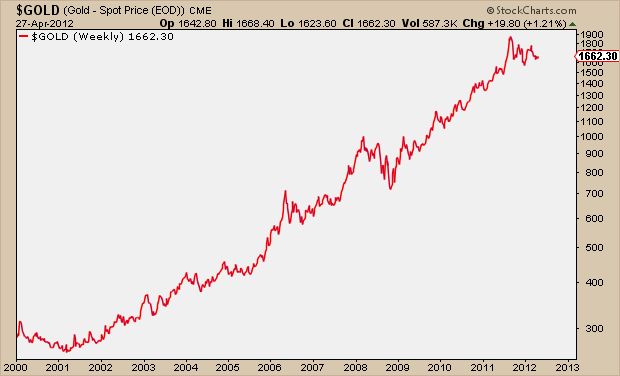
Wow!  Just WOW!

More People Have Mobile Phones Than Electricity Or Drinking Water

How big is mobile? Really big. This slide from analyst Chetan Sharma shows that mobile is the most pervasive technology ever invented.
As you can see, mobile has deeper penetration than electricity and safe drinking water.


*********************************************************************************

You all know how bullish I have been on gold and silver.  I'm glad to see that someone from a TBTF bank is no longer toeing the government/company line.

One of my favorite presentations at the MTA Symposium last week was MacNeil Curry’s. He is the current Rates and FX Strategist for Bank of America Merrill Lynch and was also one of my sponsors for the CMT program years ago. At the conference, he made some pretty big calls for Gold prices that are making headlines.

He was basically saying that trends like these don’t typically end quietly. While last year’s move in Silver ended with a parabolic move, Gold still hasn’t seen that sort of action. Until we do, this orderly advance should continue.


Here are a few things Curry had to say about Gold:

- The volatility has been nowhere near extreme enough to convince him the precious metal’s long-term uptrend was nearing the end

- From an Elliott Wave perspective, we have seen a nice, solid, orderly advance

- Any long-term commodity advance tends to end with, “a massive speculative blow-off.”

- “They don’t end quietly”. He projects gold will ascend to levels somewhere between $3,000 to $5,000 and potentially $7,000 per ounce before the rally, now in its 11th year, comes to a close.

- Gold can go parabolic completely on its own. He doesn’t think you need a world ending scenario for that.

- Gold prices would need to double in less than a year to show the kind of extreme momentum that would signal the end to the long-term cyclical uptrend. “Until we see price action take some kind of massive speculative blow-off, where prices effectively double in a year or less, I have to maintain a long-term bullish bias.”

- Gold’s price could double in a shorter time frame, and that he was watching momentum most closely for indication of the kind of speculative fluctuations that would signal an end to the secular bull trend.

********************************************************************************

I didn't think Jon Lovitz was funny while on SNL but I like him a lot in this video.

“Saturday Night Live” comedic legend Jon Lovitz is doubling down on his harsh criticism of Barack Obama’s alleged wealth confiscation and redistribution policies, claiming the president is lying to Americans.
“The President is lying to get votes … it’s obvious and transparent,” Lovitz, a self-proclaimed Democrat who voted for Obama in 2008, said on his Twitter feed Saturday night.
Lovitz was responding to criticism from those apparently in his own party, after the comic in January went on a graphic, four-letter word diatribe against Obama, calling him “a f—ing a–hole.”
Lovitz seemed a bit surprised his comments became widely reported, tweeting, “Because I criticized the President, it’s news? Last I checked, he’s President, not King! This is America! Freedom of Speech. what’s the bfd?”
One apparent liberal named Peg said to Lovitz, “This is red meat for conservatives who are trying to prove the whole country hates him, you gave them ammo, they’re using it.”
“Excuse me,” responded Lovitz, “the President is lying … I just pointed it out. It’s not my fault he’s lying.”
He added: “I haven’t gotten any backlash. I am a Democrat and liberal … Liberal, from the word “Liberty” Freedom to be who you are … be it conservative, democrat, republican, libertarian … liberal … freedom to be true to yourself … that’s what liberal means.”
Another critic told Lovitz, “You criticized the wrong president. If you’d blasted Bush, you’d be funny, smart, and possibly a hero.”
“I have blasted Bush … in my stand up act,” said Lovitz. “No one commented on it, though.”
Someone with a handle of Dan The Man told Lovitz he should pay more in taxes: “The majority of celebrities I’ve seen on TV lately say they make a lot of money & they don’t mind paying a lil more.”
Lovitz responded, “I don’t mind paying a little more. I pay my fair share now. The President is lying to get votes…it’s obvious and transparent.”
Coretta Graham then tweeted her own obscenities, telling Lovitz, “U Sir are the F*** A-hole. The rich (people making over 250k) do not pay their fair share of taxes. That is a Fact.”
“Well, you’ve proven my point,” said Lovitz. “You believe the propaganda. I know what I am paying in taxes. You are being lied to.”
“I was upset with the President LYING,” he added. “I pay my fair share of taxes and so does everyone else I know who is in the same tax bracket.”
Lovitz, best known for his catchphrase of “Yeah, that’s the ticket” by his character, the pathological liar Tommy Flanagan, dropped the F-bomb on Obama in a January podcast that became widely known last week.
The podcast, titled “The ABC’s of SNL,” was co-hosted by filmmaker Kevin Smith, and billed as being recorded “live from the Jon Lovitz Podcast Theatre.”